Before joining this class, I had only a vague understanding of the distinction between art and design. After reading Design for the Real World, this quote stood out: “Do you want it to look good or to work?”(Papanek, pg. 8). I always viewed art and design as somewhat interchangeable rather than separate modes of conceiving a product/project. I hadn’t considered that art doesn’t necessarily have to serve a function, but design does. I also thought about how design gives art function and how, while the two aren’t interchangeable, they come together to create something aesthetically appealing and functional. An example provided from this reading was the shape of a honeycomb, which demonstrates both symmetry, seen as aesthetically pleasing, while also allowing bees to build upon and dwell in, making it both pretty to look at and serving a function. I also thought about how someone can make a truly sustainable product. What I mean by this is what may be sustainable for one group of people or nation, but it may be at the expense of another group of people or nation. I think about how rich foreign entities place industrial factories in 3rd world countries at the cost of the community’s well-being, health, and financial standing. Hypothetically if they offer jobs at this factory to locals rather than transplanting people from abroad, there is still a chance that the working conditions could be unsafe or that locals could be exploited for cheaper labor. In my opinion, if this is the case, even if the product is made with “sustainable resources,” I wouldn’t consider it sustainable because of its negative impact on the surrounding community. This hypothetical is unfortunately a reflection of many large companies that use the concepts of saving the planet or community outreach while fully exploiting the people and resources around them. The terms performative activism and greenwashing come to mind.
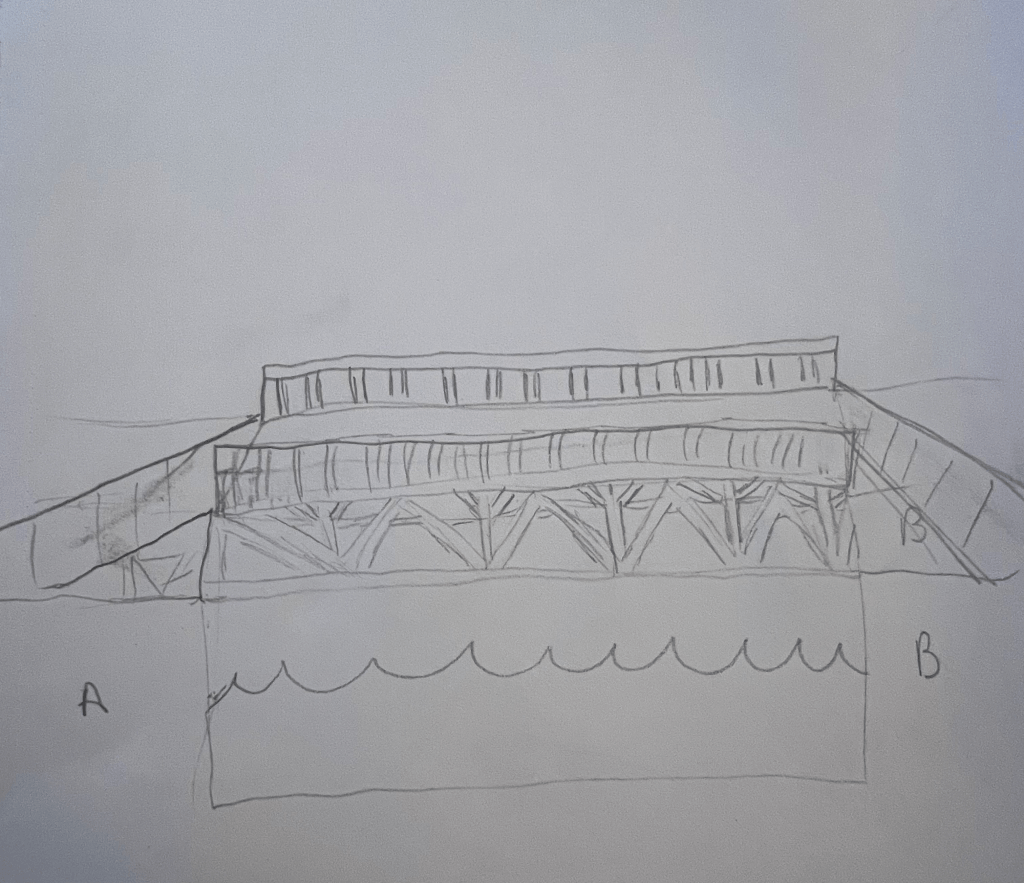
During today’s introductory exercise, we were asked to find a way to cross from point A to point B. In the first part of the exercise, when asked to sketch a bridge, I was thinking more pragmatically about providing a stable structure, the inclusion of stairs or accessibility ramps, and rails for safely commuting across. While I had some time to work on my sketches, I began overthinking small details, and this train of thought was impacting my ability to be decisive about these seemingly minor details. Only after part two of the exercise did I realize that rather than overthink these minor design factors, I should allow myself to be less practical and creative at this stage of brainstorming a means of getting from point A to point B. I drew a zipline, my reason being to add a fun experience in addition to allowing passage from one side to the other. While this method of transport is less practical and definitely has issues in terms of accessibility and safety, the idea can lead to the creation of something just as exciting while still considering how it impacts the commuter’s disposition and safety. Perhaps some people dislike zip lines or have a fear of heights, so this plan may not work. Still, if there is a way to incorporate the concept of a zip line or the thrilling emotions associated with it into a mode of transportation or a structure that allows passage, then you would have created a new way of commuting while still maintaining a practical function that provides a unique experience. It could turn something as mundane as commuting to work into something that doesn’t feel like a chore, making travel that makes travel exciting and maybe even more efficient.
 Ideation and Prototyping: A Reflection on Creation and Design